Tuesday, April 13, 2010

Cheap Frills: Penguin redesigns the classics, again

If there is one thing Anthropologie is good at, it's selling clothes—and accessories, and bed linens, and jewelry, and other do-dads—that are mass-produced, overpriced "one of a kinds." In other words, they are items that are supposed to look like you (or grandma) made them. Except you (or grandma) didn't. The artsy folks at Anthropologie did. Cheaper, more charming, and more unique things can be purchased at your local vintage shop—or on eBay!

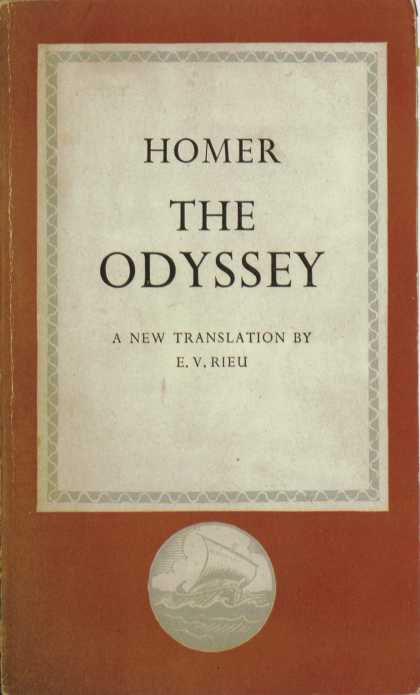
Now Anthropologie is selling 12 new embossed canvas-covered books of various classics by Penguin, including Alice in Wonderland, Great Expectations, and the Odyssey (which translator? Fagles? Lattimore? Tell me!). The books happen to jive quite well with Anthropologie's modern vintage aesthetic. They can be used easily as accessories with Anthropologie outfits. (Indeed, they are listed under "Accessories" online.) I suppose one could style the Odyssey with any of their featured "aquatic looks" of "seaside simplicity" such as "bubbling surf" and "rush of kelp." And if someone asks what you're wearing, you simply chime, "oh, a little something from the submerged series ... by anthropologie ... and homer."

Granted, I do rejoice when book design and clothing design mingle—but only as long as the books aren't treated just as acessories. I have seen and handled the new Penguin books, which appeared a few months ago in book stores (I found them at Barnes and Noble last winter), and they don't feel like books. For one, they are suspiciously light for hardbacks. Also, the paper quality isn't great, especially when you're paying 20 bones per novel. These amount to disposable versions of enduring novels. One would do better to tote an earlier printing of any of the classics, such as this one or this one, perhaps with a waterproof trench that can withstand Poseidon's blows. I think Aquascutum (Latin for "water shield") should do the trick.

Oh, and this just in: Urban Outfitters is selling the new Penguin classics, too! Along with these loud-covered, socially concious books. But of course. It's another store that mass-produces what it is to be "unique" and/or "cool."

P.S. Read more about the books at Penguin's blog here.

Sunday, March 21, 2010

Drop Dead Red


On the left, Eclipse (The Twilight Saga) by Stephanie Meyer. On the right, a look from the Talbot Runhof Fall 2010 RTW collection.

I had to pair them. She is wearing transparent greaves and patella protectors to ward off teething werewolves. And she is wearing a jawbone-skimming collar—enhanced with a giant, distracting rose—to ward off vampires.

This outfit really makes the model into the ultimate Twi-femme fetale. (And that jacket? Yes, I think it is made of genuine sunlit vampire skin.)

Unrelated, unscientific post-script: In case you are wondering, that fantastic red on the model's legs can be made with paint. Layer glazes of Cadmium Red Light and Alizarin Crimson, one after the other on a white ground. It's the sort of hue that will never come from just one tube. It looks especially vibrant beside neutral grays tinged with green.

Friday, March 19, 2010

Ingenue Nouveau


On the left, Writing Atlas (1903) by Julius Hoffmann. On the right, a look from Antonio Marras Spring 2010 RTW collection.

This book from the Jugendstil period reminds me of the work of Gustav Klimt in particular, as does the outfit, which shows and reveals a lithe female form as so many of his paintings did. Klimt also loved to engulf the body in fabric—and at times to have young skin look like ruffled, ivory fabric.

The Marras collection is made for the ingenue. So many effortless, ivory, sheer items (some far too sheer) that, depending on how you view them, seem innocent or sexy. They are definitely not cute. They are too seriously concerned with form—like the font and decoration on the book—to seem cute. The colors are exceptionally refined, too—cream, burgundy, and, elsewhere in the collection, navy, mint, black.

On a more superficial note, I like the notion of using burgundy as an accent in spring. Such a refined complement to mint.

Lastly, I'd like to direct your attention to this movie, my favorite of David Mamet's, The Winslow Boy, which features some of the best hats ever captured on film, including a stately straw one.

Thursday, March 11, 2010

A Lambist Steeped in Sentences


Meet my friend and fellow Lambist "A. Twinings." In her right hand she holds a 2004 edition of Mariage Frères: The Art of Tea, and in her left a canister of Marco Polo looseleaf tea made by the same company, which is the oldest in France and the longtime rival of Dammann Frères. Note that signature Naples yellow circle on the canister, letting you know that the leaves inside are a high quality product.

Thinking about her outfit, A. Twinings muses,
The sweater is really bright, so I was tempted to pair it with all black—an urge to which I refused to succumb, feeling contrary before my morning cup of Marco Polo tea. Instead, I chose grey tights and cream-colored Ferragamo flats with a bubbly navy skirt. Quitting coffee has turned me into a librarian-outfit-wearing tea aficionado.
P.S. Mariage Frères is sold, in America, at a few online boutiques and specialty grocery stores such as Balducci's, Williams & Sonoma, and Dean & Deluca. You can order their tea looseleaf (better value) or in muslin tea bags (slightly more convenient) here. You can also order them directly from Mariage Frères here. While Marco Polo is an excellent black tea—and one of Mariage Frères's most beloved—make sure to try their green teas, such as Yuzu Temple, and the ones of the rooibos variety, such as Rouge Bourbon Vanille. There are over 500 types to try, even one for Easter, The de Pâques, and a blue Thai one called Opium Hill.

Saturday, March 6, 2010

Venus In a Half-Shell


On the left, a copy of a TMNT comic book. On the right, a look from the Chanel Pre-Fall 2010 RTW collection.

If only down vests could turn us into Renaissance ninjas!

Friday, March 5, 2010

Beauty of the Sea Beast


On the left, a copy of Orca: The Whale Called Killer by Eric Hoyt. On the right, a look from the Jason Wu Fall 2009 RTW collection.

For a moment, imagine that somewhere in the mini-labyrinths stitched onto her skirt there is not a Minotaur, but a Marine Minotaur, i.e. a Whale Called Killer.

As my friend and colleague Jonathan V. Last points out in a great, brief article in the present issue of The Weekly Standard, "orca" is related to the Latin word orcinus, meaning, "belonging to the realm of the dead." Remember this the next time you look at blubberlicious Shamu—or even this sky-high Shamu—and are tricked into thinking he's just a cute and friendly cross between a panda and a porpoise.

Thursday, March 4, 2010

Leitmotif in Yellow


On the left, the April 18, 1869 cover of L'Eclipse by André Gill depicting Richard Wagner and his supposedly ear-splitting music. On the right, a look evoking the Golden Fleece from the Marc Jacobs Fall 2010 RTW collection.

The Jacobs collection was highly praised, but to me many of the items seemed too ill-draped or oddly proportioned—or glittery and transparent. The colors, however, were marvelous taken together—mouse grays and browns, pale neutrals, blacks, creams, and this butter yellow—and separately. Jacobs's attention to accessories, and to natural texture, is doubly lovely to behold. Consider these shoes/socks and this collar—or the subtle, rose glasses on this model that complement the round, rose-colored ear Wagner is pounding with his music on the cover of L'Eclipse.

If you click through the links to L'Eclipse and André Gill, you'll discover that La Lune, the weekly four-sheet where Gill ran his famous "The Man of the Day" caricature, was censored in December 1867 because Napoleon III, nephew to Napoleon I, so disliked this picture Gill had etched of him. An authority said to La Lune's editor that the paper would have to "undergo an eclipse." And so a new paper was born under the fitting name L'Eclipse, to which Gill contributed frequently.

Gill got into further trouble with his illustrations. Once he drew a pumpkin head people assumed to be a judge's. (This got him into court.) And another time, frustrated with the government's further attempts to quiet his pen, he drew this image titled L'Enterrement de la Caricature—"The Funeral of Caricature." On July 29, 1881, France did change its censorship laws to allow for more freedoms, but this didn't affect Gill, who, by that time, had been sent to a psychiatric hospital. Thankfully, he left a terrific paper trail for us to remember him by. See more prints "par Gill" here.